The crossroad between mediocrity and excellence.

Mediocrity1

“Most of our pocket wisdom is conceived for the use of mediocre people, to discourage them from ambitious attempts, and generally console them in their mediocrity.”
— Robert Louis Stevenson

Genius is never calculated. It is idiosyncratic, and moves in fits and starts – never a straight line.

My day of reckoning on the journey to “genius” hit a fork in the road, demanding a decision to decide my future path. I wrestled with which direction to take, perceiving one as destiny versus the other a calculate end. Each path its own rugged journey, but both options possible. My desire, tinged with the fear of not being able to feed my child, ignited dreams of successfully switching crafts, driven by an intuitive and insightful creative imagination. I never saw that 10,000 hours meant another lifetime of practice; believing my skills, although latent, would take me to the next level, despite the truth saying something different.

Instantaneous reflection sums up all that I came to be at that point: weighing options for the sake of security.

This biblical moment of choosing – changing a life path – demanded humility and acceptance of my true self within that moment. All that I was, and all that I was capable of being from years of practice whirled in wild imaginations of becoming something new. Leaning toward efficiency and the least resistant path, my delusions of grandeur fueled my ego, believing I could command any task. The appeal of the fast track to success led me to make regretted phone calls; to not realize my inconsistency; and “give randomness and ambiguity the appearance of order, structure and uniformity.” My choice quickly revealed the pedestrian nature of my new vocation.

When the paycheck becomes more important than the dream, the intuitive becomes stunted.

Artistry too easily caters to the price tag of fame, forcing the genius impulse to breed ideas outside of main street. Its idiosyncrasy becomes compromised because its first stroke, like the first thought to action, is an inchoate creative act illusively tied to prescribed financial ends. Success becomes the product sold in the galleried marketplace, not a boundless understanding of things tossed about in the imagination. The product driven genius then becomes a pseudo intelligence, channeled only to find the right path money dictated necessary.

The rhetoric of rugged individualism requires that pervasive mediocrity exists.

Managing competition inherently relies on people never reaching success, but feeling they can if compliant, reinforcing the pseudo-genius. Market forces use an American Dream “success” story to perpetuate a delusion that people buy to feel their brilliance. This contrived success masks the mediocrity. Subliminal selfish ends compromise first thoughts, which feed the stroke of the pen, brush or hand that sets out to interpret the scale of form and function. All creative acts become a competitive act.

There are no mechanisms in America where society nurtures and celebrates creative impulses for their own sake.

Artists become a happenstance – classified as some special being sitting outside the mundane, and challenging norms because they have courageously denied participating in the day-to-day ‘systems’ – or have found a means within that system which appears to extend their creativity. In this society of product driven ends, materialism forces the artist to hide in cubicles, day in and day out, until their job salaries provide enough to get them back to their real work.

The starving artist illusion, worn like a mantle, feeds the pseudo genius, who waits for the singular moment of discovery by the service of wealthy patrons.

Money coerces decisions at the crossroad. Immediately strategizing to give value to an end product, logos churns conflicted thoughts. As a well-bred daughter to my parent’s mission of robust independence and self-reliance, my creative intelligence conflicted with their conformist interpretation of working toward the golden ring. Their narrative conjured a strategy to achieve the “right” end, exemplified by possessions, such as the right house, right car and perfected dress; promoting the ‘Horatio Alger’ myth of meritocracy – man against man for position and material success.

“Mediocrity’s shallow soul finds refuge in insincere moral platitudes – such things as ‘appropriateness’ and ‘respectfulness’, ‘politeness’ and ‘civility’ – and it is by nature deferential and obsequious, and places much emphasis on status.”

Under the light of competition, strategic moves to win, become a valued monetized action, derailing the creative purpose for truth in form and function. Operating under this motive “to win” denies any imagination to internalize how structures move within time and space, negating exploration and constraining real reflection. The preoccupation with making money, and considering what that money can buy, feeds the glory and fear of star power. With this mindset, the best end is a selfish manipulated end, which always means people lose.

Calculated materialism deadens artistry, and a mediocre reality with its preconceived notion of virtuosity deadens genius.

Superficial people co-opt mediocrity to make themselves powerful. Keeping the middle ground as a cultural norm means people get just enough to satisfy their base needs, prohibiting any motive to challenge the system of power. Position and influence measures the utility and synchronicity of being, wrapped by self-serving competition, which motivates the artist’s drive to sell their craft. Art, no longer an expression of truth, becomes a commodity, pitting idea against idea like a drag race, defining those who have “it” with those “who don’t.” The price tag defines the “it” piece. The artist becomes a shoe salesman in hipster clothing.

Innovation demands our hours in the chairs consist of learning, re-learning, and surviving the cycle of success and failure.

With the multitude of people on this earth, and the different players in any given game, the best, at best, is only a fleeting moment of time. There is always someone else in the wings, or another perspective of brilliance to shine forward and capture the pockets of big donors. Playing to the benefactor curtails the freedom to think. We are too busy playing the financial catch-up game to sustain our best true selves. This game nurtures the American soul, and is nurtured by big donors, tethering all ends to our philosophy of materialism.

To rise above the tide of mediocre expectations, and its self-fulfilled prophecies, depends on accepting the obstacles to creative truth, and turning them over to something forward moving – not being afraid to stand outside the mediocre masses.

Clear vision challenges aimlessness. Fierce curiosity distracts and sidelines comfort zones. We must believe in the third eye that counters righteous indignation against the cacophony of voices, pushing and pulling the truth, over and over again, to justify their watered down norms of thinking and being, and settling to the lowest common denominator.

The artist’s truth, isolated to the fringes, rises above the fray of mediocrity when it can feel a deep connection to love and nature, and exist without the need for power.

Art gives the abstract ideas of past, present and possible futures, real constructs. This creative imagination, inherent in the birth of its being, cannot be bought. Society needs to nurture the sentient artist rather than force it to the confines of materialism and the will of wealthy often political patrons.

We must know who we are, to rise against this tide, and trust the process of becoming.

The Canon

SonicHighway_Finalepisode

Seeing the path before envisioning a completed dream.

Possibilities continually cling to secret thoughts
Narrating the poet’s script.
Desire slowly yearning for a space to show itself as
The now waits to live a second chance,
Inspired by remembrance of once being something.

The window opens and closes.

Hope searches into the vista,
Patiently breathing new air into the baggage of old skins.
Eyes materializing one truth, while
The id questions the unseen truth
Hoping the authentic self finds its sea legs.

Humanism struggles to balance the automated heart with the visceral conscience.

Walking through fear’s river of senses,
The moving moments create waves yearning for tangibility.
Practicing to stop thoughts without falling asleep.
The wind picks up the pen to the page like a brush on a canvas;
transitioning to give meaning to changing landscapes.

Whatever the platform, the eye opens to execute a hard-copy of unmitigated thoughts to the senses.

Sailing on the  paved road,
Signs pass by witnessing
The present moving to a distant past.
Memories intoxicate the imagination
Motivating the idiosyncratic stroke to be in absolute rhythm.
Only afterwards can the soul be reinvented.

A Memory Of

JohnParas

Time passes quickly, and before you know it a lot of water has rolled underneath the bridges that link the variant experiences in one’s life.

Before I moved into this current chapter of my life, I built a family with a man I barely knew. We were both in the rock and roll world – he always having managed bands, and me, always struggling to find my place and sound in way too many gigs that didn’t pay off.

We met at a meeting of friends on a Thursday night. The dark paneled rooms allowed the images of those people to stand for themselves. Against the wall’s dark chocolate canvas, whites and colors popped out in different ways, while those in black clothing could only be known by reading their faces to distinguish any personality. John’s creative aura beamed despite his posture showing the process of withdrawal still in play. The edges of his tattered leathered clothes revealed a life lived; yet his sad eyes let me know his need to still recover from the long journey of surviving hell.

Our life styles didn’t mix right off the bat, but that didn’t stop the connection. One day, after a trip upstate, I eyed a board of pictures – while gazing the faces on John’s life, a view of my future flashed before my eyes, and the gods showed me the path that would unfold. Fear inspired tears, which moved me to recoil, yet destiny’s course was already in play. Divinity drew me back in, and I could not turn my head to avoid the future.

We became parents – creating a being that has the best of both of us, and perhaps a bit of our creative demons. Our little beauty, in her divine feisty spirit, gave us both the reason to go on at that moment in our recovering lives. She represented – she represents – universal love. Her birth, a sign from our higher power, bound us, even though we eventually drifted apart.

John’s parenting differed from mine. He, like the endless child, devoted himself to creating a toy-chest, where playtime norms countered all the conservative rules of good parenting – he lived life as if anything was possible because one must allow their creative imagination to soar.

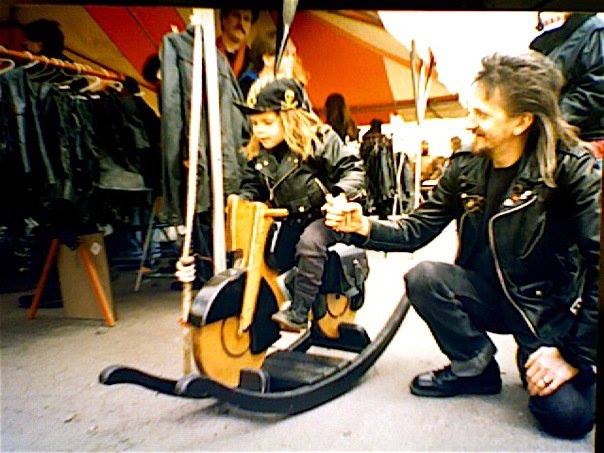
He took his daughter on motorcycle rides, while she sat on the front tank. He exposed her to early Lollapalooza shows, rocking it out in her mini leather jacket and docs. She slept in his tattoo parlor on 12th and A, like a cat in the window. Whenever they were together, the nights ended watching movies on the couch, late into the night until they both fell asleep. He created a world, where all she could imagine could come alive either on the canvas, in the poem or with the impromptu verse of her dialogue. This Dad gave his little girl a world her mother was afraid to live.

Cassie_John

Where John gave Cassie everything I could not, I gave Cassie what John could not. We were the opposite sides to a single coin: both styles of creativity necessary for an artist to make ground and be something extraordinary. In the shadow of his death, she rises like a phoenix, working through times of doubt or fear, knowing his spirit still loves and guides from the other side of her earthly dimension. Although sometimes she feels alone, she is never alone. His spirit, in constant flight, always watches over us.

We are not all genius’ in the parameters of what society dictates as genius, but we are genius in our individual ways, each and every one of us, having the power to give something of ourselves to others – to sacrifice our time and energy to help others live to their fullest potential. John gave that time and energy to his family. His love of service, his love of children, and his love of the life he imagined leaves a legacy for us to carry forward in our own endeavors as we walk our earth’s journey. It is in this mindset that we should seize the day and live the life imagined.

Carpe Diem.


A Dream

boat

I was on a ship sailing in the Caribbean looking for the way to Antigua to have a drink. The only way to get there was to sail the boat. Sailing open lanes, where there is no hard-fast direction or a singular path, afforded abandoning some other special important event that really meant nothing to inner salvation. I didn’t know I hated or feared life until I was on this boat, sailing to Antigua.

When we stopped in Jamaica, I decided to go into town and have a look around. The cacophonous streets filled with volumes of voices – different tones singing a city’s song of discordant rhythms i couldn’t get a pulse on. I looked around the sea of black faces that seemed covered in a veil of smoke, surrounding the scenes of women coveting chickens, and men cowering on the corner with cigarettes and sweating words. I kept walking in the dinginess – kept going forward to see what I could see – looking for something I wasn’t really sure about. I knew I had to get off the boat – to venture somewhere beyond that drink in Antigua – I had to go into the dragons mouth and see for myself the raw power of the netherworld – the world I dreaded yet wanted to watch with one eye open squinting from the corner of my oblivion.

As a rush of fear overtook me, I quickly turned back toward the boat. Running back to the safe shoreline, the distinction between the land and the sea – between the tremulous groundswell of a city made of quicksand, and the sea-lane that provided isolated safety, the distinctions became clearer. The water seemed to envelope the pain beneath my stance on the boat, while the land seemed to want to show it in all its disgust. Fear made me run faster – afraid that if I stopped a hand would grab me and pull me back toward the dark oblivion. If I paused, too easily the city’s tempting seductions would hit with an unstoppable force, which would change all who I am forever.

sea_sand_edge

My greatest fear – betrayal – the void created by its forced entry – propels me to always turn away – to cower into those safe holes that shield pain – a safe haven to protect my everything – fear of the external lusts, and in the process negating my lust to protect some idea of purity.

When I reached the boat my heart was racing. I told Xavier that I had not found the store I was looking for. I never really explained the store, what it was about, or what I was looking for.

The trance force of the Jamaican islands asseverated the very essence of my fear, my obsession, my self-centered desires, a black hole of total abandon, of total self-indulgent being. To shop in the store of delight only meant death in the end, and warranted me to continue on the sea lanes toward freedom from compulsion……….


My Beloved Vocation

when-i-grow-up

vocation: having a strong feeling for a particular career or occupation
beloved: dearly loved

When I first heard a writer on a TEDx clip express concern for her “beloved vocation,” my inner antennae shot a derisive gaze at the screen. Then instantly, I felt terrified that no longer would the chance to have a beloved profession prevail before the end of my years. I wondered which of my many professions from the past was – or could be in the future – beloved.

Teaching in an elite New York City high school, the apex of my academic efforts, leaves me feeling off the beam. Now that I have completed my seventh year at this school, and a total of 20 years in the ed profession, I find myself still not feeling like this job is the “everything” of who I am, or the end road. A constant redefinition of interests and goals makes me feel like I’m living on a seesaw – up and down – still deciding what I want to be when I grow up!

The students in my classes are, for the most part, are the best and the brightest of what the city offers. Each day at work is routine. I prepare singular self-contained lessons each day. I grade papers; keep track of those grades; make and administer tests; and then report to my administrator any problems, concerns or damage control. I thought this profession would give me the opportunity to inspire students, but through their eyes, I am only the task-master, becoming my own worst teacher.

I hoped to develop a vocation where I could be of service; sort of returning to the scene of the crime, and making amends for childhood rebellions. By teaching history, I hoped to not only help develop academic skills, but also offer a political forum as a means to help negotiate decision-making. I wanted collegiality among my peers, and to work in a collaborative environment, with laissez-faire support from administrators. Although idealistic, the political nature of education in and of itself bogs this  desired spirit. The thick bureaucratic ‘operational maneuverings’ leave little inspiration for me to act.

To continue up the learning ladder, I need a model to aspire to – a constructive framework. There’s only one system of operation here, and if you don’t fall into that line, your not a team player. Stifled creativity.  So I become preoccupied with figuring how much money I will make in retirement, which is at least a decade away.

I’ve lost the “beloved” notion of teaching as a noble profession. Basically, my boss told me I could only be effective, and if lucky, would visit highly effective. All my endeavors to meet my classroom goals break down in productivity reports based on student assessments. These elements make up how the system measures my effectiveness. The remnants of negative reinforcement leadership.

TEDx spots have always promoted the successes of innovators that seem to be part of collaborative work groups, in ideal work environments. It’s not in my work environment.

Work_environ

Twenty four years ago I was a new mother who occasionally substituted in elementary schools, while supporting my music career. I knew how to change diapers, play a pretty solid bass guitar, have sex and cook simple meals. I barely had time to write anything longer than a journal entry, poem/lyric or shopping list. My limited conversations discussed music, philosophy, living clean and local gossip. Despite a rocky marriage, I lived truthfully to my interests.

In my frustrated poverty-stricken haze of early motherhood, I thought going back to school was the means to some greater end. After losing the last gig because the female lead singer wanted an all male back-up, I entered the teaching profession hoping to change things. My illusions believed this manifest destiny would lead me to a higher ground outside of the paycheck utility. I traded creating, collaborating and performing music for the “noble” profession.

My self-doubt  all to often fears that this once edgy creative alpha player abandoned the creative drive because she really had no drive to begin with. Don’t get me wrong, I revel in watching my children grow and create their own world. I like having a job. However, through attrition, my self-confidence has deteriorated. I have reached a point where fear of  my mediocrity consumes me. The small possibility that this thinking is delusional feeds an energy to continue forward.  This narrow idealism holds to the small possibility, that at any point, recreation of my  creative imagination can once again flow easily through my veins.

Watching TED Talks expose me to achievers who have found a working creative imagination in their everyday vocation. Their stories of how successes and failures helped shaped their accomplishments bear witness to how a passion for learning, questioning, and discipline keeps these men and women on a course to rarely compromise. I need more hours in the chair to do the job that doesn’t yearn to be somewhere else, and brings together all of my life’s experiences into a single craft that exemplifies my fullest potential. To protect a “beloved vocation.”

Image

Expectations

expectations1

Noreaster Hercules had everyone up in arms about a possible snow day. Students kept asking. “Do you think classes will be cancelled?”

My pragmatic response dulled hopes, but aimed to offer a solution to the inevitable dashed expectations. “Don’t expect a snow day, so if there isn’t one you won’t be too resentful, and if there is one, you’ll be surprised!”

Lessen expectations.

A difficult task.

Constant challenges holding on to expectations deadens synchronicity. Although striving to let go of them, I always fall short. Left to my thinking (a dangerous place), I am constantly confronted with wrangling through the mire of persons not acting the way I expect them to act, leaving myself on a ledge, forced to let go.

Tonight at a pleasant dinner, I spoke with another country and western friend, who enjoyed the Green and White Mountains as much as I do. He mentioned that loving those hills lies deep within one’s being, and I understood. Drawn to the tree on the mountaintop, like a gravitational pull, the mountains seem to have no expectations. The only needed action would be to choose a maneuver to navigate the slope.

I did not always know how to find the right path. I all too often focused on the way my foot deliberately manipulated between the rocks and sticks. I intently watched my steps, carefully choosing what I perceived as the steady ground, while striving for the perfect footing and balance to stand just right or move deliberately graceful through the woods.

Compulsively holding tight to the way my leg moved forward than back, pushed me further away from accepting just what my foot was capable of doing on its own. If I lost my footing, I cursed the ground, or blamed externals for something that had no real intent to do harm to me.

I never accepted that I chose that path, that I forced my foot to do what I expected should be done. I forfeited responsibility for creating any skewed ground. Too much effort kept me from the ease of the path where the water flowed.

The more I meticulously watched myself and others, while trying to take the perfect step, the less my steps were effortless or right. Not until I let go of making things happen, did things begin to happen.

A lifetime of mistakes have passed. Now, moving through the glades seems easier when I let go and ride my path where the water flows.

a state of being whole and undivided.

Integrity

I don’t profess to being the most solid individual in the world, but I strive to have some sense of integrity about my dealings with colleagues. However, patience spreads thin when I see blatant injustices for the sake of power positioning. My whole temporal being becomes unhinged, and clear sight quickly impairs. Rash behaviors take hold, and no sooner than the feeling of fear hitting at the very core of my being emerges, I have blurted out something controversial. The gasp from my colleagues in the room stifles any clear sensibility on my part.

In an instant, I feverishly begin to tread water, attempting to control what clearly reveals a wrong on my part. Fast, the loss of control overcomes me. I earnestly attempt to right the wrong, but humans have little patience: they see what they want to see. Each word or phrase that attempts to set the wrong right creates further uncomfortable moments, while at the same time providing food for destruction from those who would love to tear me down.

The intrigue of people to view crashes has always amazed me. I often get sucked into rubbernecking at accidents. It’s as if witnessing the destruction somehow absolves me from destructive defects. The goal of any participant in our dog-eat-dog competitive world depends on finding the flaws in “competitors,” which would provide opportunities of “growth. Players, ingrained to cast slings and arrows against the misfortunate, slither throughout the work environment. Compassion would be considered a sign of weakness – a player loosing ground. So to expect empathy in any given work situation would be delusional. Public high schools, transformed by the corporate impulse, are not exempt from this callousness.

After being exposed to office intrigue about who rattled whose cage, my instinct to leave this job loomed large. My life passed before me, and the idea that the rest of my work days would be subject to petty power struggles in public school buildings became depressing. Principles over personalities seems a hopeless, far away concept, since over the past seven years Principals have abused workplace ethics to feel a sense of power in their powerless position of imposing a uniform pedagogy over a variety of disciplines.

A wise woman once told me that the course of experience will lead one to see ‘how it works, and how it doesn’t work.’ Living then becomes the choosing of which path I decide to stroll down. Such a viewpoint requires that I remain teachable at any given turn, and open-minded to a new way of living as the years change the world I built around me. All that I know, and all that I assumed would be, become questionable as I begin another cycle of deciding what I want to become when I grow up.

My aged world begins the third stage of a great ride  – assuming that Saturn’s return designates each stage – I get to choose the kind of person I would like to become, not only by example, but for personal sanity. Reinvention, which can begin at any point, requires a powerful intuitive imagination that connects to a steadfast commitment of a rational idea (this rationality remains the tricky part of negotiating between the dichotomy of a concerted philosophical discourse and intoxicating small talk).

The passionate belief of “anything is possible if you imagine it” commits to the genuine idea that I still possess the opportunity to reinvent and create my life anew. Many detractors of change reject my thinking in their attempt to protect safe cultural norms and deny their own stagnation. As an architect of reinvention, I must consistently refresh my faithfulness to teachability. To innovate means to set in motion and organize the day-to-day necessities of creating a “something” with disciplined patience and practice. Faith breeds change, and safeguards the construction process. The daily, and equally disciplined, practice of conscious contact insures the reverence to the gift of being not only in the process of change, but in the moment of being in and of itself. Humility helps me to keep me at bay the fearful force of those persons, afraid of losing ground, who set out to tear such innovation down.

One’s truth questioning voice must remain steadfast in the things constructed. True intentions, subject to truth tests and exposed to the light of day, lead to a state of perfection. Yet these acts of expression must also be measured by a level of fair-mindedness, compassion and empathy. As a result, integrity develops as a continuing process of becoming. A life of dignity then remains my choice to stay in the process of change.

Image

An Instant

In an instant the world you know can change. So many writings discuss events where the world of the protagonist changes through one dramatic event. The before life, shows a world of independent thinking, freedom, choice and hope. The event – symbolic or not – rocks the foundation of that world. The after-life represents all the fears one may have worked hard to avoid. The challenge then becomes the process of acceptance. My mother’s car accident changed her life, while accentuating the assets and liabilities already in play in my life.

Mom totaled her car.  She came around a bend going faster than expected and caught air. In flight, the car spun around and came down in a wooded area off the road hitting trees in the back of the car and all along the left side. The front left part of the engine was smashed in, as well a the back-side.

.Mom

For most young persons, this type of accident would be a coming of age story where the young hero walks away without a scratch. Youth heals, and the tale would perhaps be the campfire storytelling of a vivid lead up to the climatic clash with a ferocious tree! For Mom, this accident represented a life changed – where the world she knew would no longer exist.

Mom will no longer drive. Mom will no longer be able to live in the house she has lived in for almost 50 years. Mom will no longer be able to act on her intellectual impulse. She will only feel constant pain. The arthritis will only increase, and Mom will never be able to pick up anything heavier than her purse. In essence, her ability to care for herself, by herself, cannot be.  Dependency overtakes and overwhelms.

My sister called about two hours after the accident had occurred, when the doctors were running the tests. I then quickly tied loose ends together, and got into hospital mode. I had practice with this type of emergency because Mom, hospitalized last year during the Sandy Hurricane, broke her pelvis. After securing care for Max, my son, I made a sandwich, at the suggestion of a friend, to make sure I ate gluten-free before becoming wrapped into the hospital’s drama. On my way, I stopped for gas. I got there approximately two hours after the phone call, and felt a pang of guilt that it wasn’t fast enough.

Mom went to the same hospital, and so the steps to her room triggered memories of fear. Yet when I approached her room, the feelings swelled inside me in a new way, as if approaching a passage way into another dimension. Whereas the previous stay, tamed by the lack of severity, this stay would signal the beginning of an end. I walked into the room where she laid, swollen and drugged, and almost fainted.

I looked for water to calm my nerves and to find my breadth. My thoughts were racing and no single one penetrated a phrase that signaled what I was feeling. I tried to find my balance as I quickly searched for a cup of water at the nurses station. My nephew followed me from the urging of his “nurse” wife. He asked if I was alright. This familiar fainting feeling resembled the morning I almost passed out of the subway from a vasovagel response from iron depletion. My nutrients escaped from my brain. I was about to hit the floor when the water touched my lips, and I was somehow brought back to face my fear of death.

Mom cracked jokes in-between saying how stupid she felt. She vacillated between highs and lows like riding a roller coaster. Her thoughts, like slippery hands trying to hang onto a greased pole, were in one moment coherent and in the next mumblings. Her slurred speech clearly showed that she was not truly present to the events unfolding.

So as the evening turned to night, and night to early morning, I slipped away while she slept. Driving the 40 minute journey back to the city, my emotional exhaustion really could not grasp the changes. Intellectually, I understood, but emotionally I refused to feel.

The doctor scheduled Mom’s surgery on the third day in the hospital. The swelling throughout her injuries needed to subside. The shattered upper left arm beneath her broken collar-bone needed plates and pins. No one seemed concerned about her arthritis ridden back and leg pains which plagued her over the last six months, which ‘miraculously’ disappeared with the multitude of percosets she ate every 3 hours.  Like a shadow thought that sits in the back of the brain never showing itself but shrouding all thoughts, I knew the worst pain was yet to come.

I never spoke about these feelings in the presence of my mother. When I tried to broach the subject with my sister, she, in her own way to survive her feelings, pushed back to keep this in the present. In meetings with friends I shared my concern, but little in the way of feedback played out. There was no more than a nod or “sorry to hear about your mother” response. My private feelings sat heavy, wearing me out as each day passed.

The surgery went well, and during the doctor’s follow-up meeting the next morning, she cracked jokes to a very patient doctor, while I tried to deflect her humor to the seriousness of the meeting. Mom’s coping mechanism against heavy feelings plays out with making funny faces and cracking jokes. She’s perfected this skill of deflection. Feelings are not her forte, and she always believed that people would naturally work through them. But this  life and death situation depends on a healthy attitude about life, and to bring forward, at one’s base of thinking, acceptance. Mom’s challenge would yet unfold. Her new life would take away freedoms she had not yet fully processed.

About a week after the surgery Mom transferred to a rehabilitation hospital. My oldest sister, Mom’s medical proxy, daily tended to Mom’s medical and spiritual needs. I was able to visit around my work schedule at least one day during the week and on weekends. Daily, my sister and I would phone convo to go over strategy plans to bring Mom to a more positive view of recovery. Sis had a tough road, and she handled each day with grace and ease. The tasks were all to familiar since Sis had walked her significant other through the process of dying two years before.

When I could make my way to the hospital around my work schedule, I kept company with Mom. We watched old movies that we had each seen a hundred times, and gossiped about the actors. In fact, whoever showed up was basically watching old movies with Mom. But when She and I watched movies, it was like it had always been since I was a child – passing time as a way of finding a common ground.

My sister and I scheduled family to make sure that each evening there was always someone visiting. Our intent to help Mom feel positive about her healing process worked as long as a live body kept her company. During the downtimes, she became despondent. Each morning into afternoon, Mom vacillated between acceptance and fear. My sister got the brunt of this up and down, and would call to fill me in. We were both afraid that she would in an instant, give up.

Lying on her back, day after day, with now only the occasional painkiller, the arthritis slowly reappeared. Her physical therapist provided the exercises to heal the arm, yet no doctor could cure that merging dull pain that had previously gone through a series of epidurals prior to the accident. Dull gave way to sharp episodes, which eventually become a single stream of unending discomfort.

Where the hospital provided a safe haven to heal, Mom yearned for self-sufficiency. Her wishful thinking laid out a picture that she could return to her house, and live her life. Yet  we knew the truth; that the world she had come to accept, would be no more. She was officially dependent.

The process for each of her daughters has been to realign each’s commitment to my mother in her last years. It would need showing up; sitting patiently watching her move uncomfortably through the pain; watching movies, cooking meals, running errands or just biding some time between conversations that avoided acknowledgment of such care. Sacrificing our selfish interests would hopefully give relief to her fear that she would be alone.

Mom’s pride always starts the conversation when we ask how she’s doing. It gets in the way of asking for help. If we show up, help is there. Yet a decorum is needed to dance around her exhortations of “I can take care of myself!”

We exclaim, “No, really Mom, I had no plans for the weekend, and I thought just to come out to spend time with you.” Estelle demands, “You can come as long as you aren’t taking care of me – I’m fine!”

So although a ruse progresses, I willingly do all that I can to experience all that there is. By giving my time, I give my gift of love. But returning home with such frequency does have some on the job hazards. Each time I enter her house (my childhood home) memories come in and out.  Downstairs I relive my Ken and Barbie days, watching TV, and growing up in my imagination. As I go into the darker closets, growing pains bring memories of shame and frustration. Although prone to obsess and regret, I busy myself, and play a recovery tape that tells me to accept myself for just as i am in that moment; not who I was worlds past. Just for today, I am present for this closure.