
I want to be like Ann Richards when I grow up.
I want to be like Ann Richards when I grow up.

Seeing the path before envisioning a completed dream.
Possibilities continually cling to secret thoughts
Narrating the poet’s script.
Desire slowly yearning for a space to show itself as
The now waits to live a second chance,
Inspired by remembrance of once being something.
The window opens and closes.
Hope searches into the vista,
Patiently breathing new air into the baggage of old skins.
Eyes materializing one truth, while
The id questions the unseen truth
Hoping the authentic self finds its sea legs.
Humanism struggles to balance the automated heart with the visceral conscience.
Walking through fear’s river of senses,
The moving moments create waves yearning for tangibility.
Practicing to stop thoughts without falling asleep.
The wind picks up the pen to the page like a brush on a canvas;
transitioning to give meaning to changing landscapes.
Whatever the platform, the eye opens to execute a hard-copy of unmitigated thoughts to the senses.
Sailing on the paved road,
Signs pass by witnessing
The present moving to a distant past.
Memories intoxicate the imagination
Motivating the idiosyncratic stroke to be in absolute rhythm.
Only afterwards can the soul be reinvented.
A predator is a predator, no matter how much they are loved.

Time passes quickly, and before you know it a lot of water has rolled underneath the bridges that link the variant experiences in one’s life.
Before I moved into this current chapter of my life, I built a family with a man I barely knew. We were both in the rock and roll world – he always having managed bands, and me, always struggling to find my place and sound in way too many gigs that didn’t pay off.
We met at a meeting of friends on a Thursday night. The dark paneled rooms allowed the images of those people to stand for themselves. Against the wall’s dark chocolate canvas, whites and colors popped out in different ways, while those in black clothing could only be known by reading their faces to distinguish any personality. John’s creative aura beamed despite his posture showing the process of withdrawal still in play. The edges of his tattered leathered clothes revealed a life lived; yet his sad eyes let me know his need to still recover from the long journey of surviving hell.
Our life styles didn’t mix right off the bat, but that didn’t stop the connection. One day, after a trip upstate, I eyed a board of pictures – while gazing the faces on John’s life, a view of my future flashed before my eyes, and the gods showed me the path that would unfold. Fear inspired tears, which moved me to recoil, yet destiny’s course was already in play. Divinity drew me back in, and I could not turn my head to avoid the future.
We became parents – creating a being that has the best of both of us, and perhaps a bit of our creative demons. Our little beauty, in her divine feisty spirit, gave us both the reason to go on at that moment in our recovering lives. She represented – she represents – universal love. Her birth, a sign from our higher power, bound us, even though we eventually drifted apart.
John’s parenting differed from mine. He, like the endless child, devoted himself to creating a toy-chest, where playtime norms countered all the conservative rules of good parenting – he lived life as if anything was possible because one must allow their creative imagination to soar.
He took his daughter on motorcycle rides, while she sat on the front tank. He exposed her to early Lollapalooza shows, rocking it out in her mini leather jacket and docs. She slept in his tattoo parlor on 12th and A, like a cat in the window. Whenever they were together, the nights ended watching movies on the couch, late into the night until they both fell asleep. He created a world, where all she could imagine could come alive either on the canvas, in the poem or with the impromptu verse of her dialogue. This Dad gave his little girl a world her mother was afraid to live.
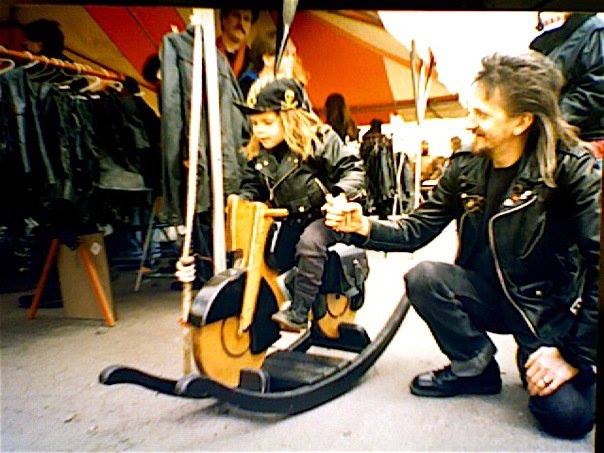
Where John gave Cassie everything I could not, I gave Cassie what John could not. We were the opposite sides to a single coin: both styles of creativity necessary for an artist to make ground and be something extraordinary. In the shadow of his death, she rises like a phoenix, working through times of doubt or fear, knowing his spirit still loves and guides from the other side of her earthly dimension. Although sometimes she feels alone, she is never alone. His spirit, in constant flight, always watches over us.
We are not all genius’ in the parameters of what society dictates as genius, but we are genius in our individual ways, each and every one of us, having the power to give something of ourselves to others – to sacrifice our time and energy to help others live to their fullest potential. John gave that time and energy to his family. His love of service, his love of children, and his love of the life he imagined leaves a legacy for us to carry forward in our own endeavors as we walk our earth’s journey. It is in this mindset that we should seize the day and live the life imagined.
Carpe Diem.

I was on a ship sailing in the Caribbean looking for the way to Antigua to have a drink. The only way to get there was to sail the boat. Sailing open lanes, where there is no hard-fast direction or a singular path, afforded abandoning some other special important event that really meant nothing to inner salvation. I didn’t know I hated or feared life until I was on this boat, sailing to Antigua.
When we stopped in Jamaica, I decided to go into town and have a look around. The cacophonous streets filled with volumes of voices – different tones singing a city’s song of discordant rhythms i couldn’t get a pulse on. I looked around the sea of black faces that seemed covered in a veil of smoke, surrounding the scenes of women coveting chickens, and men cowering on the corner with cigarettes and sweating words. I kept walking in the dinginess – kept going forward to see what I could see – looking for something I wasn’t really sure about. I knew I had to get off the boat – to venture somewhere beyond that drink in Antigua – I had to go into the dragons mouth and see for myself the raw power of the netherworld – the world I dreaded yet wanted to watch with one eye open squinting from the corner of my oblivion.
As a rush of fear overtook me, I quickly turned back toward the boat. Running back to the safe shoreline, the distinction between the land and the sea – between the tremulous groundswell of a city made of quicksand, and the sea-lane that provided isolated safety, the distinctions became clearer. The water seemed to envelope the pain beneath my stance on the boat, while the land seemed to want to show it in all its disgust. Fear made me run faster – afraid that if I stopped a hand would grab me and pull me back toward the dark oblivion. If I paused, too easily the city’s tempting seductions would hit with an unstoppable force, which would change all who I am forever.
My greatest fear – betrayal – the void created by its forced entry – propels me to always turn away – to cower into those safe holes that shield pain – a safe haven to protect my everything – fear of the external lusts, and in the process negating my lust to protect some idea of purity.
When I reached the boat my heart was racing. I told Xavier that I had not found the store I was looking for. I never really explained the store, what it was about, or what I was looking for.
The trance force of the Jamaican islands asseverated the very essence of my fear, my obsession, my self-centered desires, a black hole of total abandon, of total self-indulgent being. To shop in the store of delight only meant death in the end, and warranted me to continue on the sea lanes toward freedom from compulsion……….

vocation: having a strong feeling for a particular career or occupation
beloved: dearly loved
When I first heard a writer on a TEDx clip express concern for her “beloved vocation,” my inner antennae shot a derisive gaze at the screen. Then instantly, I felt terrified that no longer would the chance to have a beloved profession prevail before the end of my years. I wondered which of my many professions from the past was – or could be in the future – beloved.
Teaching in an elite New York City high school, the apex of my academic efforts, leaves me feeling off the beam. Now that I have completed my seventh year at this school, and a total of 20 years in the ed profession, I find myself still not feeling like this job is the “everything” of who I am, or the end road. A constant redefinition of interests and goals makes me feel like I’m living on a seesaw – up and down – still deciding what I want to be when I grow up!
The students in my classes are, for the most part, are the best and the brightest of what the city offers. Each day at work is routine. I prepare singular self-contained lessons each day. I grade papers; keep track of those grades; make and administer tests; and then report to my administrator any problems, concerns or damage control. I thought this profession would give me the opportunity to inspire students, but through their eyes, I am only the task-master, becoming my own worst teacher.
I hoped to develop a vocation where I could be of service; sort of returning to the scene of the crime, and making amends for childhood rebellions. By teaching history, I hoped to not only help develop academic skills, but also offer a political forum as a means to help negotiate decision-making. I wanted collegiality among my peers, and to work in a collaborative environment, with laissez-faire support from administrators. Although idealistic, the political nature of education in and of itself bogs this desired spirit. The thick bureaucratic ‘operational maneuverings’ leave little inspiration for me to act.
To continue up the learning ladder, I need a model to aspire to – a constructive framework. There’s only one system of operation here, and if you don’t fall into that line, your not a team player. Stifled creativity. So I become preoccupied with figuring how much money I will make in retirement, which is at least a decade away.
I’ve lost the “beloved” notion of teaching as a noble profession. Basically, my boss told me I could only be effective, and if lucky, would visit highly effective. All my endeavors to meet my classroom goals break down in productivity reports based on student assessments. These elements make up how the system measures my effectiveness. The remnants of negative reinforcement leadership.
TEDx spots have always promoted the successes of innovators that seem to be part of collaborative work groups, in ideal work environments. It’s not in my work environment.

Twenty four years ago I was a new mother who occasionally substituted in elementary schools, while supporting my music career. I knew how to change diapers, play a pretty solid bass guitar, have sex and cook simple meals. I barely had time to write anything longer than a journal entry, poem/lyric or shopping list. My limited conversations discussed music, philosophy, living clean and local gossip. Despite a rocky marriage, I lived truthfully to my interests.
In my frustrated poverty-stricken haze of early motherhood, I thought going back to school was the means to some greater end. After losing the last gig because the female lead singer wanted an all male back-up, I entered the teaching profession hoping to change things. My illusions believed this manifest destiny would lead me to a higher ground outside of the paycheck utility. I traded creating, collaborating and performing music for the “noble” profession.
My self-doubt all to often fears that this once edgy creative alpha player abandoned the creative drive because she really had no drive to begin with. Don’t get me wrong, I revel in watching my children grow and create their own world. I like having a job. However, through attrition, my self-confidence has deteriorated. I have reached a point where fear of my mediocrity consumes me. The small possibility that this thinking is delusional feeds an energy to continue forward. This narrow idealism holds to the small possibility, that at any point, recreation of my creative imagination can once again flow easily through my veins.
Watching TED Talks expose me to achievers who have found a working creative imagination in their everyday vocation. Their stories of how successes and failures helped shaped their accomplishments bear witness to how a passion for learning, questioning, and discipline keeps these men and women on a course to rarely compromise. I need more hours in the chair to do the job that doesn’t yearn to be somewhere else, and brings together all of my life’s experiences into a single craft that exemplifies my fullest potential. To protect a “beloved vocation.”

Noreaster Hercules had everyone up in arms about a possible snow day. Students kept asking. “Do you think classes will be cancelled?”
My pragmatic response dulled hopes, but aimed to offer a solution to the inevitable dashed expectations. “Don’t expect a snow day, so if there isn’t one you won’t be too resentful, and if there is one, you’ll be surprised!”
Lessen expectations.
A difficult task.
Constant challenges holding on to expectations deadens synchronicity. Although striving to let go of them, I always fall short. Left to my thinking (a dangerous place), I am constantly confronted with wrangling through the mire of persons not acting the way I expect them to act, leaving myself on a ledge, forced to let go.
Tonight at a pleasant dinner, I spoke with another country and western friend, who enjoyed the Green and White Mountains as much as I do. He mentioned that loving those hills lies deep within one’s being, and I understood. Drawn to the tree on the mountaintop, like a gravitational pull, the mountains seem to have no expectations. The only needed action would be to choose a maneuver to navigate the slope.
I did not always know how to find the right path. I all too often focused on the way my foot deliberately manipulated between the rocks and sticks. I intently watched my steps, carefully choosing what I perceived as the steady ground, while striving for the perfect footing and balance to stand just right or move deliberately graceful through the woods.
Compulsively holding tight to the way my leg moved forward than back, pushed me further away from accepting just what my foot was capable of doing on its own. If I lost my footing, I cursed the ground, or blamed externals for something that had no real intent to do harm to me.
I never accepted that I chose that path, that I forced my foot to do what I expected should be done. I forfeited responsibility for creating any skewed ground. Too much effort kept me from the ease of the path where the water flowed.
The more I meticulously watched myself and others, while trying to take the perfect step, the less my steps were effortless or right. Not until I let go of making things happen, did things begin to happen.
A lifetime of mistakes have passed. Now, moving through the glades seems easier when I let go and ride my path where the water flows.
So far this year has been one of re-invention, and accepting who I am in the moment I experience myself. Finding that means to a brighter end has its ups and downs.
Saturday morning, after a sleepless night, deep feelings of disappointment, futility and sadness veiled my soul. Throughout the morning, my surface enthusiasm smiled with the ease of social acceptability. I usually control superfluous relations, but underneath — behind my closed feelings, I concertedly work through the invisible sheath of despair. My efforts these past couple of months bore no deep holes that broke through to release the poisonous fumes at the base of my being. Although, my NEH Philosophy seminar this past month did allow me to make some concerted ground, I still woke this past Saturday feeling the weight of fear.
Our move back to the city, now 10 months ago, tried my expectations. My work throughout the spring became uninteresting, and I labored over completing too many tasks. I let go of old relationships, and started new ones. I made the choice to write as a new mode of expression, while struggling to find the time. My daydreams reminisced about the choices not taken, rather than staying ‘in the solution of’ today’s problems. Although feeling financially and professionally stuck, my self-determination stayed the course. I put one foot in front of the other — looking forward. When those self-deprecating moments seemed to elude progress, I worked hard to feel gratitude.
I’m healthier today than when times were flush — all diseases remain in stage 1. Most cannot truly wrap their thinking around what it means to be a celiac sprue patient. Although I still struggle with eating the wrong foods, or buying the wrong lotion, I persevere. Often people’s desires to put me at ease only frustrate me. Every day reminds me that my health defines who I am.
This week I set goals for myself — clean the house — sort the papers — write the recommendations for my student’s college letters. I accomplished nothing — no task seemed pressing. I walked through moments detached. Materialism began to preoccupy my thinking in cunning and insidious ways, as the city worked its wiles on me.
While walking the NYC streets on my way downtown, my gazes only registered what I didn’t have. I saw fancy cars, designer shoes, new clothes, and apartments for sale that were once within reach, but now an impossibility. I felt like my brain was not fast and nimble enough. I tore apart my teaching and parenting abilities, and castigated my lacking desire to achieve. Shallow consumerism glaringly overtook, and led me to anger and resentment of everything I had become. The delusions overwhelmed me.
The Powerball Lottery provided a momentary escape. While driving from here to there I fantasized about winning, and what I would do with the millions of dollars – I dreamed a life of money property and prestige, supported by my benevolence, prudence and compassion. This delusion obsessed that such a future was possible. It puffed me up – supported me to walk taller and feel special. I lifted myself so high in this dream that the fall back to reality was crushing. Today, the bill collector called. I could not get out of bed.
It is when I put these feelings to paper, and retreat to this page, that I find my way back. The gift of being human is our ability to reflect, and to make decisions. If I give fear a constructive platform outside of my head, the negatives dissipate. Through the editing process, I drank water; made sure I had plenty of sleep, and went for a 3 mile walk and aligned with right breathe.
Exposing resentments to the light of writing opens a door to new possibilities. The story becomes the means to an end.
With the recent Supreme Court decision that declares the 1964 Voting Rights Act unconstitutional, the question of fair treatment rises as a central concern of our polity. The appearances of normalcy – equal treatment – are illusions in our society. The concerted efforts by conservative groups in the last presidential election reveals that America is still highly divided, yet we all do not see our division easily.
What masks this division, which history shows us, is the nation’s growing materialism – if all citizens have full access to goods and services, their responsibility is to rise up and utilize those opportunities through self-motivating forces. Simple psychology reveals that defacto racism, sexism and classism are not easily distinguished by laws. So believing that numbers designate a defacto change in psycho-social behavior becomes too clearly a tool for monied conservatives to mask their gross intentions to prohibit the “opposition” protection from laws that could easily constrain equal access.
About 10 years ago a young woman of 24 told me that if women feel they are ill treated or are singled out through discriminatory practices they are deluded. In her zealous youth she failed to understand that efforts of women to equalize the playing field through pay check equality, sexual rights and job opportunities had still not been reached. In 2002, women still earned 25% less than men, and only 1% of the top decision making positions in business were occupied by women. Although women have made incredible gains, it has come through the sacrifice of women to lay themselves down on the gauntlet and fight for those rights. Women’s rights are not self evident in patriarchal minds. Minority rights are not self evident with defacto racism. Sexual rights are not self evident in homophobic maternalist thinking.
Throughout history, laws for broadening the rights of citizenship have only come from bloodshed in some form or other. The failed application of the 14th amendment by the United States government in every state of the union throughout the 19th century was only rectified by brave men and women who had the courage to stand up and put their lives on the line to challenge the wrong. Although they experienced many defeats, they kept going forward – they leaned forward – they passed their message from generation to generation. It is our current generation that seems to feel paralyzed from not only understanding the impacts of the conservative laws, but stymied by the increasing feeling that as long as one’s basic needs are met, all is well. All is not well, as our society moves back to Gilded Age economics, and its psycho-social underpinnings.
In America, money represents the key to freedom – the relationship is inherent in the constitution’s very way that it was constructed – a coup of the financial elites over the notion of populism. The elites never believed the people were educated enough to make civic decisions, so they constructed a system by which the majority of peoples in the republic could not vote to change or make the laws of the state. Those laws were changed only when the power elites needed those votes to maintain their hegemony. Throughout our democractic experiment, money always begot power. However, power corrupts, and the economic debacles of the last decade confirm it so.
The interpretation of the powerful court all too easily becomes the byway of partisan power, constructed through the financial power of a silent minority (the 1%), who’s position is threatened by democratic thinking – allowing populism to dictate any norms of the market. Conservatism is the minority, but they hold the majority of wealth and political power. Since we are a nation built on democratic capitalism, our first thought is that if I or the nation are financially sound, than the system is sound. With that thinking, the fight for equal rights, equal access of the financial and political disenfranchised, cannot come about until we see ourselves as disenfranchised.
While reading Emerson on a hot humid lawn, nature’s sounds orchestrated my musings of his essay on poets. Rich in language, Emerson attempted to give a verbally seductive argument that painted a variety of emotional responses to the bad poetry of his day. His rational descriptive arguments sliced point to point through essayed rhetoric, giving a clearer portrait not only of the poet, but of an artist.
I was astounded by a single line. After a long description of genius, Emerson captured the essential element necessary for the artist to be an artist. He claimed, that genius expresses itself not only in the prescriptive forms, but more so through an “insight which expresses itself by what is called Imagination … [which] does not come by study, but by the intellect being where and what it sees, by sharing the path, or circuit of things through forms, and so making them translucid to others.” This qualia of creative imagination, within any medium, provides the foundation for genius in all disciplines.
We entered the library for the lecture.
The Emerson lecture started well, but slowly digressed because of contradicting analyses of the professor. I stopped listening after two hours of general claims that provided no documentation to prove veracity. My attention then diverted to look within the faces of my peers to see their reactions to these undocumented interpretations, conflating theory on theory, imposed by professorial privilege.
The faces of my peers painted stern contemplations. I projected that these captive learners felt the same confusions I experienced. I noticed their eyes slowly buried themselves under furrowed brows, and downturned smiles that began to sleep with eyes wide opened. We sat what seemed like an eternity, battling out the artistic relevance of a single piece of text; debating whether Frederick Douglas’ narrative was a work of art, outside of its utility to argue against the harms of slavery within this certain place and time.
The questions went round and round for hours. Should we consider memoir art? Is autobiography art, history, philosophy? We compared one of notoriety versus the dulled exhortations of those less talented writers. Questions whirled on the meaning of language: When is a sentence art? How can we know the intention of the writer? If all literature is art (Iris Murdoch) is a manuscript art? The questioning seemed circular.
Electrified by the contradictions, my instincts engined utterances of metaphor upon metaphor that challenged the biased analysis whenever given the chance to speak. My underlying objection to the absence of historicism in the discussion grounded my critiques. IF we analyze a piece of literature, its very essence of being claims that this intellectual property has a history. The examination of form and function, and the choices the author makes is grounded in a person’s psychology and event context. People don’t write in a vacuum. They are motivated by forces that in many ways are cultivated by alliances, and the impact of tangible external events. Philosophers more easily consider historicism, but English teachers have greater difficulty, as the text in and of itself is the primary concern.
We all gave our conclusions with detailed examples that often derailed the initial point. In the end, most participants resisted moving outside their disciplines, and so discourse met dead ends. Conclusions were left to the eye of the beholder. After hours of moving through this single author’s writing, questions about its artistic relevance remained unanswered, and historicism was swept under the rug.
Sitting for long hours makes me uncomfortable. I couldn’t help obsessing about the professors contradicting assertions. My arrogance of rightness empowered my privilege of thinking, thus I felt justified in giving my two cents whenever the moment allowed. My impatient views empowered my ego. Later, upon reflection, I felt embarrassed by my assumptions, falling into self absorbed thinking that my exhortations were of a false humility. Like a monkey that sits silently on my back, the truth that my problematic early years failed to diligently read and write feeds a repeating low self-esteem about my academic abilities. This self deprecation feeds a self-preserving, perhaps self-righteous, desire to be right.
At the end of this day long session, mental exhaustion from sitting too long overtook my atrophying legs. Although I struggled to lift myself out of the chair, once standing, I briskly made my way back to the dorm. As the hot humid weather drenched me during this mile walk home, my inner dialogue spoke aloud to an invisable audience.
In these moments of reflection, I relived my actions like a memoir, making arguments – claims and warrants – that fleetingly questioned my process. Fear is such a cunning enemy of intellect. Through my self-imposed training to turn fearful thoughts over to positive self-affirmations, I looked to just what was before me – the rationality of my arguments.
Language too easily confounds perspective. One’s chosen word to define a point in time can be contrary to the definitions used in other disciplinary contexts. Discourse then serves to clarify the confusions, and helps to build a common ground. For the surviving self, these moments of learning nurture the intuitive perspective through open-mindedness to things unimagined by the naked eye.
 The Experimental Writings of D-Davis